
Inside the Missouri Court System
Missouri's court system has three constitutional levels. They are the Circuit Courts, the Missouri Court of Appeals, and the Supreme Court of Missouri. The Circuit Courts are the trial courts of general jurisdiction. Appeals go first to the Court of Appeals. That court sits in Eastern, Southern, and Western Districts. The Supreme Court hears categories assigned directly by the constitution and may take transferred cases. Circuit boundaries group 114 counties and the independent City of St. Louis into 46 circuits. So one circuit can cover more than one county.
Within each Circuit Court, divisions handle criminal, civil, associate, probate, family, juvenile, and municipal matters. Associate and municipal divisions are not separate constitutional tiers. The Circuit Clerk or court administrator keeps the trial record. A municipal division clerk or assigned staff handles ordinance cases. Each appellate district has its own clerk and a separate appeal docket. That split in responsibility matters. A statewide search helps locate a case, yet the official record stays with the court level that holds it.
Missouri's 46 Circuits Serve 115 Localities
Missouri runs its trial courts through 46 judicial circuits. Together they cover 114 counties plus the independent City of St. Louis. That makes 115 localities in all. That math matters for a docket search. Start with the county or city named on your case papers and work out which circuit it sits in. A circuit does not always match a county. Boone and Callaway, for instance, share the 13th Circuit. The state court directory draws the circuit lines, and the county directory below points the way to each local docket site.
The Circuit Court is where trials happen. Its divisions sort cases by statute and assignment. A municipal ordinance citation might start in a city division inside the Circuit Court. An associate division may handle a preliminary felony hearing before a later circuit filing. So the count of circuits and localities describes the system's geography, not one docket per county and not one office for every case type.
The Missouri Statewide Search Portal
Missouri Case.net is the judiciary's public case-search site. It pulls case information from the statewide court automation system. Public matters recorded by Circuit Court divisions are included. The official guide lists four ways in: Litigant Name, Filing Date, Case Number, and Scheduled Hearings & Trials. A search can return the case number, style, type, docket entries, and settings. It also links to documents you are allowed to see. For the search categories and the full field inventory, see Case Lookup.
Case.net is not a full historical archive. Confidential case types, document-level restrictions, and legacy records all shape what shows up. The judiciary's current access notice reflects changes effective July 1, 2026. A single case may not appear. That does not mean its county is missing from the system. One missing case is just one missing case.
| Portal Feature | What It Covers | Where It Falls Short |
|---|---|---|
| Case Index | Public records in the statewide Circuit Court automation system. | No universal oldest-year table; protected and pre-implementation records may need local access. |
| Docket Detail | Case identity, parties, docket entries, and settings when public. | The official docket/backer sheet and file remain with the clerk. |
| Documents | Eligible public document links in the File Viewer. | Case type, document security, date, and user role affect access. |
| Updates | The judiciary describes public information as real time. | No exact refresh or uptime service level is promised. |
OSCA Administers Missouri Court Technology
The Office of State Courts Administrator goes by OSCA. It supports the Supreme Court, the trial courts, and the appellate courts across Missouri. Its work covers court automation, Case.net and eFiling support, reporting, and day-to-day operations. Missouri Constitution Article V, Section 4 gives the Supreme Court power to appoint an administrator and staff. OSCA runs under that structure. The public Case.net system comes from the judiciary itself. It is not a private docket vendor.
OSCA's Help Desk handles system questions, while the clerk holding a case answers record-specific ones. If a document will not open, ask the local court about its access classification. Do not ask OSCA to fetch a county file. The OSCA office page and eFiling FAQ list statewide contacts and help information.
Office of State Courts Administrator
Statewide administration, court automation, Case.net and eFiling support
How Missouri Dockets Reach the State Index
A Missouri case starts in the Circuit Court division with authority over that filing. Attorneys and approved groups can file through the Missouri eFiling System. Other accepted routes exist too. Court staff then process the papers. The activity goes into the statewide automation system. From there, Case.net shows the public layer of the docket, limited by confidentiality rules and each document's access status.
Missouri docket flow: Filing with the court › division record and docket sheet › statewide automation › Case.net public view
Nothing in this setup takes the official file away from the local court. The clerk or division staff still holds it. Ask that office about older records, paper items, and certified copies. Every county appears to sit inside the statewide index. Confidential cases may not show up remotely. Files that predate local implementation may not either. The case number and the entry text still come from the same local docket either way. Use the county directory to reach the right Circuit Court locality.
Pre-Automation Missouri Files Stay Local
Missouri automation did not arrive everywhere at once. Rule 4.01 ordered a uniform statewide recordkeeping system for listed case categories. Yet it also lets a division keep older cases in a prior manual or electronic system that already complied. Rule 4.02 goes further and blesses several formats: paper, microfilm, microfiche, and electronic media. So statewide technology proves nothing about any single old file. No one start year covers every Missouri case.
Suppose an older case never shows up in Case.net. Confirm the case number and court, then ask the circuit clerk directly. The file may live in a prior system, a paper docket book, or an archive. The clerk can say whether a local terminal or a retrieval request is required. The judiciary's public materials give no universal date range across courts. The clerk who holds the docket can tell you what format the record is kept in. That same clerk can say whether it is still available.
E-Filing Through Missouri eFiling System
The Missouri eFiling System is the judiciary's channel for submitting court documents electronically. Registered attorneys and other approved filers use it. It launched statewide in 2011. It grew through later court rules and rollout phases. Once the court accepts a filing, the document becomes part of the case record. Case.net is the public search side, not the filing screen. An ordinary person looking up a public case needs no attorney eFiling account.
Attorney access is authenticated and tied to permissions on each case and document. Most self-represented litigants still file on paper. That holds unless an approved exception or a limited online transaction applies. E-filing does not erase court costs. Payment processing charges can attach to e-check or card payments. Those amounts change. The live Missouri FAQ is the right place to check them. One caution: a filed document is not automatically viewable remotely by every Case.net user.
Missouri's Circuit Divisions Are One Court
Missouri's associate and municipal divisions are parts of the Circuit Court, not separate tiers. An associate division handles statutory work. That includes many misdemeanors, preliminary felony proceedings, and limited civil procedures. A municipal division hears city ordinance matters, including municipal traffic cases. Public materials may still say "municipal court." That habit of speech does not create a freestanding constitutional court.
The distinction matters when you run a case search. A city citation belongs to that named municipal division. A state-law ticket may land in an associate division or another Circuit Court division instead. A municipal appeal or trial de novo can open a related Circuit Court case. It carries a different number. Case.net can help you find both records. But the clerk for each file controls its docket and the route to copies. Never treat one docket entry as a stand-in for the other.
Missouri Portal vs County Docket
Case.net and the local Circuit Clerk answer different questions. The statewide portal answers discovery. It shows which public case matches a name, a case number, a date, or a hearing. The clerk answers the record itself. That means what is in the official file, what is restricted, and how to get a certified copy. A Case.net result may be enough to identify the case and read public docket entries. For a complete docket sheet, older material, or certification, go to the court that holds the file through the county directory.
| Feature | Statewide Portal | County Docket |
|---|---|---|
| Coverage | Public index across Missouri's statewide court automation system. | The case and files held by a particular Circuit Court division. |
| Docket Detail | Public case details, docket entries, and settings as available. | Official docket or backer sheet and filed documents. |
| Documents | Eligible links, subject to access rule, case type, date, and user role. | Official file access through the clerk or public terminal. |
| Certified Copies | Online printouts are not clerk-certified. | Ask the clerk for the official copy and local fee. |
Missouri Appeals Start a New Docket
An appeal does not continue the trial docket. It starts a new one. The Missouri Court of Appeals has Eastern, Southern, and Western Districts. Some matters go straight to the Supreme Court or are transferred there under governing rules. The appellate clerk holds the appeal's briefs, notices, orders, and opinion. The circuit clerk keeps the original trial record. The clerk prepares the legal file or transcript for review.
A trial entry reading "notice of appeal" is a clue, not a substitute. Search again for the appellate docket. Use the appellate case number from filed papers or the court's case-information page. Federal matters run on a different track. Use the federal district court and Eighth Circuit routes instead. State appellate records and federal PACER records sit in separate court systems. The Eastern District of Missouri's official map lays out its federal divisions and the counties they cover.
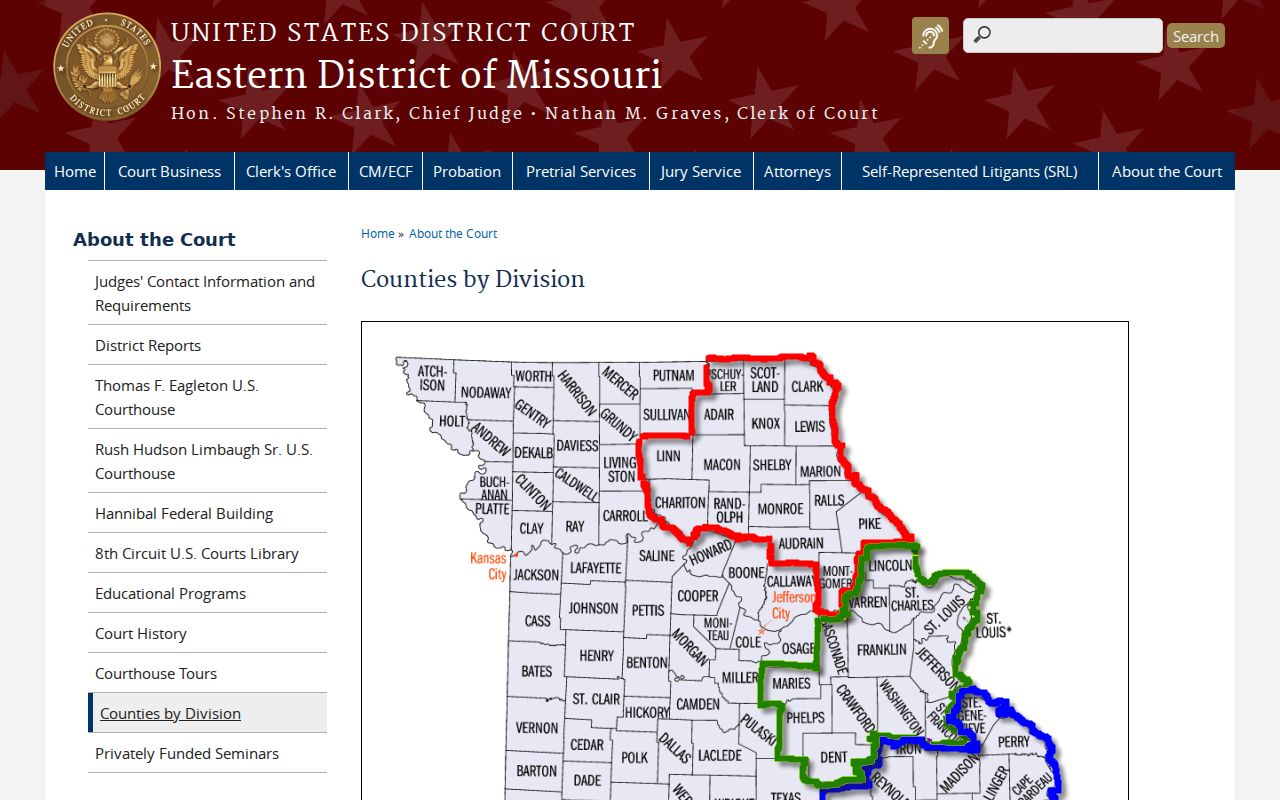
Federal, not state: this map covers federal divisions only. Missouri's state-court circuits and Court of Appeals districts follow different boundaries.
Missouri Court Technology and History
Missouri built its court technology in stages. The 1979 reorganization created the modern unified structure. Rule 4 later set uniform recordkeeping. The judiciary now reports every municipal court in statewide automation. Case.net got a major public upgrade in 2004, though no uncontested first-launch year exists. Statewide e-filing began in 2011. Remote public access to eligible documents expanded in 2023. It is revised again effective July 1, 2026.
Each milestone changed how people find a Missouri case. None erased the older paper record or opened every attachment to the public. Access today depends on the updated Rule 2 guidance. It also turns on the case type, document security, and your role. When the public portal shows nothing, try the courthouse terminal or ask the local clerk. The system is statewide. But custody and the practical route to a record still run through the division holding the case.
Missouri's 2024 Server Recovery
Missouri's courts went through a rough patch with their servers. In its February 2025 State of the Judiciary report, the judiciary described an electrical event during the prior summer. Court operations were back to normal within days. Rebuilding data-system capacity took longer. That report offers helpful context for anyone tracking a Missouri court docket. It was never a live outage notice, and it proves nothing about any single docket's reliability.
When a hearing date matters, go straight to the source. The latest filed notice and the assigned court beat any online index. Case.net is a public tool, not a promise of perfect uptime. OSCA keeps the statewide system running. For one specific case number or hearing, the clerk or court coordinator is still the person to call.